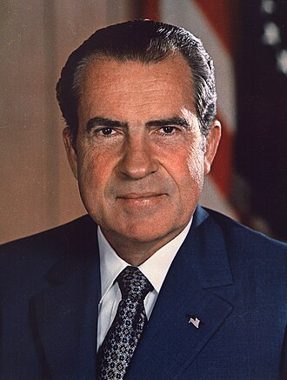
Richard Nixon
US politicians
Photo: Department of Defense. Department of the Army. Office of the Deputy Chief of Sta, Public domain · Wikimedia Commons

Position estimated from: Presidency 1969-74: EPA, wage and price controls, opening to China, "law and order", Watergate.
Political compass placement
| Map dimension | Score (0–100) | Position | Reading |
|---|---|---|---|
| Economic Collective / planned ↔ Market | 52 | near the center | |
| Social Progressive ↔ Traditional | 65 | toward traditional | |
| Authority Libertarian ↔ Authoritarian | 54 | near the center | |
| National identity Cosmopolitan ↔ Nationalist | 65 | near the center | |
| Foreign policy Non-intervention ↔ Intervention | 66 | toward intervention |
All nine underlying dimensions
| Dimension | Score | Reading |
|---|---|---|
| Economic ownership Collective ownership ↔ Private ownership | 66 | toward private ownership |
| Civil liberties Civil liberty ↔ State restrictions | 62 | near the center |
| National identity Cosmopolitan ↔ Nationalist | 65 | near the center |
| Social and cultural values Progressive ↔ Traditionalist | 71 | toward traditionalist |
| Political governance Democratic ↔ Autocratic | 47 | near the center |
| Equality and hierarchy Egalitarian ↔ Hierarchical | 58 | near the center |
| Economic management Free market ↔ State planning | 68 | toward state planning |
| Military intervention Non-intervention ↔ Intervention | 66 | toward intervention |
| Religion and government Secular state ↔ Religious authority | 53 | near the center |
These positions are estimates on the Atlas’s nine-dimension scale, produced by running the available evidence through the same questions and scoring used for test-takers. They are interpretations for comparison, not objective measurements. How scores are made.
Key positions
| Statement | Position | Basis |
|---|---|---|
| A national religious authority should have the power to veto legislation. | Strongly disagrees | estimated |
| The means of production should ultimately be owned collectively. | Strongly disagrees | estimated |
| Opposition parties should be free to compete in elections. | Strongly agrees | estimated |
| The government should cap prices for essential goods during normal economic conditions. | Strongly agrees | from their record |
| National borders should become less important over time. | Strongly disagrees | estimated |
| Foreign wars should be avoided unless national territory is directly threatened. | Strongly disagrees | estimated |
| National security can justify restrictions on what journalists publish. | Agrees | estimated |
| Traditional values should guide what society considers right and wrong. | Agrees | estimated |
| Class distinctions should gradually disappear. | Strongly disagrees | estimated |
| Regulations on business should be minimized whenever possible. | Strongly disagrees | estimated |
Closest ideologies
Paternalistic Conservatism86% similar positionDevelopmentalism86% similar positionOne-Nation Conservatism84% similar positionPeronism84% similar positionCentrism84% similar position
Similar and contrasting figures
Woodrow Wilson91% similar · US politiciansTheodore Roosevelt89% similar · US politiciansAlexander Hamilton88% similar · US politiciansNiccolò Machiavelli87% similar · Historical and internationalKonrad Adenauer87% similar · Historical and internationalPeter KropotkinContrasting: 47% similarMikhail BakuninContrasting: 48% similarNoam ChomskyContrasting: 54% similar
Sources
Profile last reviewed October 11, 2026.