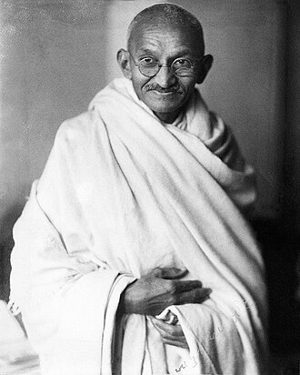
Mahatma Gandhi
Historical and international
Photo: Elliott & Fry, Public domain · Wikimedia Commons

Position estimated from: Independence movement: non-violence, swadeshi self-reliance, village-centred traditionalism. (Same person as "Mohandas Gandhi".)
Political compass placement
| Map dimension | Score (0–100) | Position | Reading |
|---|---|---|---|
| Economic Collective / planned ↔ Market | 39 | near the center | |
| Social Progressive ↔ Traditional | 72 | toward traditional | |
| Authority Libertarian ↔ Authoritarian | 18 | toward libertarian | |
| National identity Cosmopolitan ↔ Nationalist | 60 | near the center | |
| Foreign policy Non-intervention ↔ Intervention | 3 | strongly toward non-intervention |
All nine underlying dimensions
| Dimension | Score | Reading |
|---|---|---|
| Economic ownership Collective ownership ↔ Private ownership | 35 | near the center |
| Civil liberties Civil liberty ↔ State restrictions | 22 | toward civil liberty |
| National identity Cosmopolitan ↔ Nationalist | 60 | near the center |
| Social and cultural values Progressive ↔ Traditionalist | 80 | toward traditionalist |
| Political governance Democratic ↔ Autocratic | 14 | strongly toward democratic |
| Equality and hierarchy Egalitarian ↔ Hierarchical | 27 | toward egalitarian |
| Economic management Free market ↔ State planning | 54 | near the center |
| Military intervention Non-intervention ↔ Intervention | 3 | strongly toward non-intervention |
| Religion and government Secular state ↔ Religious authority | 52 | near the center |
These positions are estimates on the Atlas’s nine-dimension scale, produced by running the available evidence through the same questions and scoring used for test-takers. They are interpretations for comparison, not objective measurements. How scores are made.
Key positions
| Statement | Position | Basis |
|---|---|---|
| The government should be able to restrict how certain religions are practiced, such as their places of worship, clothing or schools. | Strongly disagrees | from their record |
| Opposition parties should be free to compete in elections. | Strongly agrees | estimated |
| People should be free to criticize the government without fear of legal punishment. | Strongly agrees | estimated |
| Central economic planning is preferable to decentralized market decisions. | Strongly disagrees | estimated |
| Military power should be used proactively when serious external threats are emerging. | Strongly disagrees | estimated |
| Society works best when established social hierarchies are respected. | Strongly disagrees | estimated |
| Traditional values should guide what society considers right and wrong. | Strongly agrees | estimated |
| National borders should become less important over time. | Strongly disagrees | estimated |
| A government-run health insurance option should be available to everyone. | Strongly agrees | estimated |
| Retirement savings should be held in private accounts rather than a government pension system. | Strongly disagrees | estimated |
Closest ideologies
Christian Humanism87% similar positionAgrarian Socialism86% similar positionLocalism86% similar positionDistributism86% similar positionAgrarianism85% similar position
Similar and contrasting figures
Malcolm X85% similar · US politiciansMartin Luther King Jr.84% similar · US politiciansJacques Maritain84% similar · Historical and internationalRobert F. Kennedy Jr.83% similar · US politiciansJean-Jacques Rousseau83% similar · Historical and internationalAdolf HitlerContrasting: 42% similarBenito MussoliniContrasting: 46% similarNapoleon BonaparteContrasting: 48% similar
Sources
Profile last reviewed October 11, 2026.