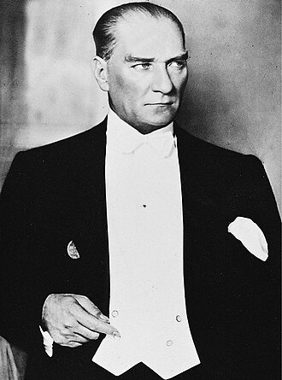
Mustafa Kemal Atatürk
Historical and international
Photo: Unknown authorUnknown author, Public domain · Wikimedia Commons

Position estimated from: Founder of the Turkish Republic: secularization, Westernizing reforms, one-party nationalism, statism.
Political compass placement
| Map dimension | Score (0–100) | Position | Reading |
|---|---|---|---|
| Economic Collective / planned ↔ Market | 43 | near the center | |
| Social Progressive ↔ Traditional | 21 | toward progressive | |
| Authority Libertarian ↔ Authoritarian | 79 | toward authoritarian | |
| National identity Cosmopolitan ↔ Nationalist | 92 | strongly toward nationalist | |
| Foreign policy Non-intervention ↔ Intervention | 40 | near the center |
All nine underlying dimensions
| Dimension | Score | Reading |
|---|---|---|
| Economic ownership Collective ownership ↔ Private ownership | 55 | near the center |
| Civil liberties Civil liberty ↔ State restrictions | 72 | toward state restrictions |
| National identity Cosmopolitan ↔ Nationalist | 92 | strongly toward nationalist |
| Social and cultural values Progressive ↔ Traditionalist | 24 | toward progressive |
| Political governance Democratic ↔ Autocratic | 86 | strongly toward autocratic |
| Equality and hierarchy Egalitarian ↔ Hierarchical | 48 | near the center |
| Economic management Free market ↔ State planning | 75 | toward state planning |
| Military intervention Non-intervention ↔ Intervention | 40 | near the center |
| Religion and government Secular state ↔ Religious authority | 15 | strongly toward secular state |
These positions are estimates on the Atlas’s nine-dimension scale, produced by running the available evidence through the same questions and scoring used for test-takers. They are interpretations for comparison, not objective measurements. How scores are made.
Key positions
| Statement | Position | Basis |
|---|---|---|
| The government should be able to restrict how certain religions are practiced, such as their places of worship, clothing or schools. | Agrees | from their record |
| The means of production should ultimately be owned collectively. | Strongly disagrees | estimated |
| National borders should become less important over time. | Strongly disagrees | estimated |
| Same-sex couples should have the same right to marry as opposite-sex couples. | Strongly agrees | estimated |
| A strong leader who gets things done matters more than following proper procedures. | Strongly agrees | estimated |
| During a pandemic, governments should be able to close businesses and places of worship. | Strongly agrees | estimated |
| Regulations on business should be minimized whenever possible. | Strongly disagrees | estimated |
| Society works best when established social hierarchies are respected. | Disagrees | estimated |
| Military power should be used proactively when serious external threats are emerging. | Disagrees | estimated |
| The government should not favor any religion through public funding. | Strongly agrees | estimated |
Closest ideologies
Kemalism89% similar positionTechnocratic Authoritarianism80% similar positionState Capitalism79% similar positionDevelopmentalism79% similar positionState Socialism77% similar position
Similar and contrasting figures
Deng Xiaoping85% similar · Historical and internationalIndira Gandhi83% similar · Historical and internationalMaximilien Robespierre83% similar · Historical and internationalGamal Abdel Nasser82% similar · Historical and internationalSun Yat-sen81% similar · Historical and internationalPeter KropotkinContrasting: 46% similarDorothy DayContrasting: 47% similarMikhail BakuninContrasting: 47% similar
Sources
Profile last reviewed October 11, 2026.