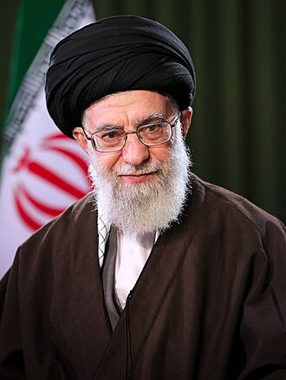

Position estimated from: Supreme Leader of Iran 1989-present: velayat-e faqih clerical rule, proxy network abroad.
Political compass placement
| Map dimension | Score (0–100) | Position | Reading |
|---|---|---|---|
| Economic Collective / planned ↔ Market | 33 | toward collective / planned | |
| Social Progressive ↔ Traditional | 100 | strongly toward traditional | |
| Authority Libertarian ↔ Authoritarian | 89 | strongly toward authoritarian | |
| National identity Cosmopolitan ↔ Nationalist | 87 | strongly toward nationalist | |
| Foreign policy Non-intervention ↔ Intervention | 78 | toward intervention |
All nine underlying dimensions
| Dimension | Score | Reading |
|---|---|---|
| Economic ownership Collective ownership ↔ Private ownership | 40 | near the center |
| Civil liberties Civil liberty ↔ State restrictions | 80 | toward state restrictions |
| National identity Cosmopolitan ↔ Nationalist | 87 | strongly toward nationalist |
| Social and cultural values Progressive ↔ Traditionalist | 100 | strongly toward traditionalist |
| Political governance Democratic ↔ Autocratic | 98 | strongly toward autocratic |
| Equality and hierarchy Egalitarian ↔ Hierarchical | 78 | toward hierarchical |
| Economic management Free market ↔ State planning | 78 | toward state planning |
| Military intervention Non-intervention ↔ Intervention | 78 | toward intervention |
| Religion and government Secular state ↔ Religious authority | 100 | strongly toward religious authority |
These positions are estimates on the Atlas’s nine-dimension scale, produced by running the available evidence through the same questions and scoring used for test-takers. They are interpretations for comparison, not objective measurements. How scores are made.
Key positions
| Statement | Position | Basis |
|---|---|---|
| A national religious authority should have the power to veto legislation. | Strongly agrees | from their record |
| National borders should become less important over time. | Strongly disagrees | estimated |
| Traditional values should guide what society considers right and wrong. | Strongly agrees | estimated |
| National security can justify restrictions on what journalists publish. | Strongly agrees | estimated |
| A strong leader who gets things done matters more than following proper procedures. | Strongly agrees | estimated |
| Foreign wars should be avoided unless national territory is directly threatened. | Strongly disagrees | estimated |
| Class distinctions should gradually disappear. | Strongly disagrees | estimated |
| Markets generally distribute goods more effectively than government planners. | Strongly disagrees | estimated |
| The means of production should ultimately be owned collectively. | Disagrees | estimated |
| A naturalized citizen can belong to the nation as fully as someone born there. | Disagrees | estimated |
Closest ideologies
Falangeism89% similar positionFascism89% similar positionItalian Fascism88% similar positionTheocracy87% similar positionIslamism86% similar position
Similar and contrasting figures
José Antonio Primo de Rivera89% similar · Historical and internationalRecep Tayyip Erdoğan89% similar · Historical and internationalBenito Mussolini87% similar · Historical and internationalVladimir Putin87% similar · Historical and internationalAdolf Hitler85% similar · Historical and internationalPeter KropotkinContrasting: 25% similarMikhail BakuninContrasting: 26% similarNoam ChomskyContrasting: 31% similar
Sources
Profile last reviewed October 11, 2026.