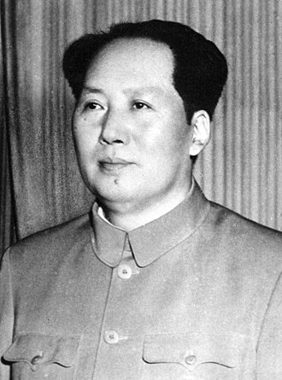
Mao Zedong
Historical and international
Photo: Chen Zhengqing (1917–1966), Public domain · Wikimedia Commons

Position estimated from: PRC leadership 1949-76: collectivization, Great Leap Forward, Cultural Revolution.
Political compass placement
| Map dimension | Score (0–100) | Position | Reading |
|---|---|---|---|
| Economic Collective / planned ↔ Market | 2 | strongly toward collective / planned | |
| Social Progressive ↔ Traditional | 30 | toward progressive | |
| Authority Libertarian ↔ Authoritarian | 92 | strongly toward authoritarian | |
| National identity Cosmopolitan ↔ Nationalist | 75 | toward nationalist | |
| Foreign policy Non-intervention ↔ Intervention | 55 | near the center |
All nine underlying dimensions
| Dimension | Score | Reading |
|---|---|---|
| Economic ownership Collective ownership ↔ Private ownership | 3 | strongly toward collective ownership |
| Civil liberties Civil liberty ↔ State restrictions | 86 | strongly toward state restrictions |
| National identity Cosmopolitan ↔ Nationalist | 75 | toward nationalist |
| Social and cultural values Progressive ↔ Traditionalist | 35 | near the center |
| Political governance Democratic ↔ Autocratic | 99 | strongly toward autocratic |
| Equality and hierarchy Egalitarian ↔ Hierarchical | 46 | near the center |
| Economic management Free market ↔ State planning | 100 | strongly toward state planning |
| Military intervention Non-intervention ↔ Intervention | 55 | near the center |
| Religion and government Secular state ↔ Religious authority | 19 | toward secular state |
These positions are estimates on the Atlas’s nine-dimension scale, produced by running the available evidence through the same questions and scoring used for test-takers. They are interpretations for comparison, not objective measurements. How scores are made.
Key positions
| Statement | Position | Basis |
|---|---|---|
| Central economic planning is preferable to decentralized market decisions. | Strongly agrees | from their record |
| Religious doctrine should take precedence over civil law when they conflict. | Strongly disagrees | estimated |
| A single ruling party can govern more effectively than a competitive multiparty system. | Agrees | estimated |
| Major industries should be publicly owned rather than privately controlled. | Strongly agrees | estimated |
| National security can justify restrictions on what journalists publish. | Strongly agrees | estimated |
| National borders should become less important over time. | Strongly disagrees | estimated |
| Same-sex couples should have the same right to marry as opposite-sex couples. | Strongly agrees | estimated |
| Reducing the gap between rich and poor should be a major government goal. | Agrees | estimated |
| Non-intervention should be the default even when allies request military assistance. | Strongly disagrees | estimated |
| Governments should be able to require vaccination during a public health emergency. | Strongly agrees | estimated |
Closest ideologies
State Socialism91% similar positionMarxism–Leninism91% similar positionMaoism89% similar positionAuthoritarian Socialism88% similar positionTitoism84% similar position
Similar and contrasting figures
Ho Chi Minh93% similar · Historical and internationalFidel Castro92% similar · Historical and internationalJosip Broz Tito89% similar · Historical and internationalNicolás Maduro89% similar · Historical and internationalGamal Abdel Nasser87% similar · Historical and internationalMurray RothbardContrasting: 35% similarRon PaulContrasting: 35% similarDave SmithContrasting: 36% similar
Sources
Profile last reviewed October 11, 2026.