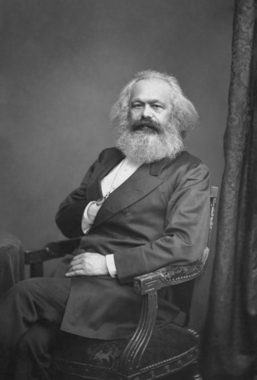
Karl Marx
Historical and international
Photo: John Jabez Edwin Mayall, Public domain · Wikimedia Commons

Position estimated from: Communist Manifesto, Capital, The Civil War in France: abolition of private ownership of the means of production, internationalism. Fought press censorship and backed universal suffrage, but endorsed a revolutionary "dictatorship of the proletariat", compulsory labour ("equal liability of all to work"), and the Paris Commune model of elected, recallable judges and a merged executive-legislature in place of constitutional checks.
Political compass placement
| Map dimension | Score (0–100) | Position | Reading |
|---|---|---|---|
| Economic Collective / planned ↔ Market | 4 | strongly toward collective / planned | |
| Social Progressive ↔ Traditional | 17 | toward progressive | |
| Authority Libertarian ↔ Authoritarian | 42 | near the center | |
| National identity Cosmopolitan ↔ Nationalist | 8 | strongly toward cosmopolitan | |
| Foreign policy Non-intervention ↔ Intervention | 30 | toward non-intervention |
All nine underlying dimensions
| Dimension | Score | Reading |
|---|---|---|
| Economic ownership Collective ownership ↔ Private ownership | 0 | strongly toward collective ownership |
| Civil liberties Civil liberty ↔ State restrictions | 46 | near the center |
| National identity Cosmopolitan ↔ Nationalist | 8 | strongly toward cosmopolitan |
| Social and cultural values Progressive ↔ Traditionalist | 20 | toward progressive |
| Political governance Democratic ↔ Autocratic | 38 | near the center |
| Equality and hierarchy Egalitarian ↔ Hierarchical | 0 | strongly toward egalitarian |
| Economic management Free market ↔ State planning | 90 | strongly toward state planning |
| Military intervention Non-intervention ↔ Intervention | 30 | toward non-intervention |
| Religion and government Secular state ↔ Religious authority | 10 | strongly toward secular state |
These positions are estimates on the Atlas’s nine-dimension scale, produced by running the available evidence through the same questions and scoring used for test-takers. They are interpretations for comparison, not objective measurements. How scores are made.
Key positions
| Statement | Position | Basis |
|---|---|---|
| The means of production should ultimately be owned collectively. | Strongly agrees | from their record |
| People should be free to criticize the government without fear of legal punishment. | Strongly agrees | from their record |
| A single ruling party can govern more effectively than a competitive multiparty system. | Strongly disagrees | from their record |
| Reducing the gap between rich and poor should be a major government goal. | Strongly agrees | from their record |
| Religious doctrine should take precedence over civil law when they conflict. | Strongly disagrees | estimated |
| A naturalized citizen can belong to the nation as fully as someone born there. | Strongly agrees | estimated |
| Same-sex couples should have the same right to marry as opposite-sex couples. | Strongly agrees | estimated |
| Markets generally distribute goods more effectively than government planners. | Strongly disagrees | estimated |
| Military power should be used proactively when serious external threats are emerging. | Strongly disagrees | estimated |
| Traditional elites have a legitimate special role in public life. | Strongly disagrees | estimated |
Closest ideologies
Similar and contrasting figures
Sources
Profile last reviewed October 11, 2026.