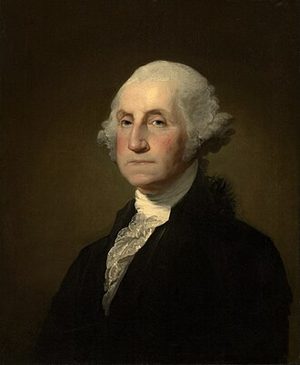

Position estimated from: Presidency 1789-97 and Farewell Address: warned against permanent foreign alliances and faction; set the two-term precedent; suppressed the Whiskey Rebellion; backed Hamilton's financial program.
Political compass placement
| Map dimension | Score (0–100) | Position | Reading |
|---|---|---|---|
| Economic Collective / planned ↔ Market | 67 | toward market | |
| Social Progressive ↔ Traditional | 70 | toward traditional | |
| Authority Libertarian ↔ Authoritarian | 34 | toward libertarian | |
| National identity Cosmopolitan ↔ Nationalist | 65 | near the center | |
| Foreign policy Non-intervention ↔ Intervention | 20 | toward non-intervention |
All nine underlying dimensions
| Dimension | Score | Reading |
|---|---|---|
| Economic ownership Collective ownership ↔ Private ownership | 75 | toward private ownership |
| Civil liberties Civil liberty ↔ State restrictions | 43 | near the center |
| National identity Cosmopolitan ↔ Nationalist | 65 | near the center |
| Social and cultural values Progressive ↔ Traditionalist | 75 | toward traditionalist |
| Political governance Democratic ↔ Autocratic | 25 | toward democratic |
| Equality and hierarchy Egalitarian ↔ Hierarchical | 71 | toward hierarchical |
| Economic management Free market ↔ State planning | 45 | near the center |
| Military intervention Non-intervention ↔ Intervention | 20 | toward non-intervention |
| Religion and government Secular state ↔ Religious authority | 57 | near the center |
These positions are estimates on the Atlas’s nine-dimension scale, produced by running the available evidence through the same questions and scoring used for test-takers. They are interpretations for comparison, not objective measurements. How scores are made.
Key positions
| Statement | Position | Basis |
|---|---|---|
| The means of production should ultimately be owned collectively. | Strongly disagrees | estimated |
| Opposition parties should be free to compete in elections. | Agrees | from their record |
| A national religious authority should have the power to veto legislation. | Strongly disagrees | estimated |
| Central economic planning is preferable to decentralized market decisions. | Strongly disagrees | estimated |
| People should be free to criticize the government without fear of legal punishment. | Strongly agrees | estimated |
| Military power should be used proactively when serious external threats are emerging. | Strongly disagrees | estimated |
| National borders should become less important over time. | Strongly disagrees | estimated |
| Traditional values should guide what society considers right and wrong. | Strongly agrees | estimated |
| Class distinctions should gradually disappear. | Strongly disagrees | estimated |
| Private property rights should generally protect productive businesses from government takeover. | Strongly agrees | estimated |
Closest ideologies
Traditional Conservatism92% similar positionOne-Nation Conservatism92% similar positionModerate Conservatism92% similar positionSocial Conservatism91% similar positionConservative Populism90% similar position
Similar and contrasting figures
Tim Pool90% similar · CommentatorsCandace Owens89% similar · CommentatorsVivek Ramaswamy89% similar · US politiciansMatt Walsh88% similar · CommentatorsNigel Farage88% similar · Historical and internationalChe GuevaraContrasting: 49% similarLeon TrotskyContrasting: 49% similarPeter KropotkinContrasting: 51% similar
Sources
Profile last reviewed October 11, 2026.